.png?width=64&height=64&name=artificial-intelligence%20(3).png)



Search for a PCBA manufacturer in Thailand and you will find ranked lists. Most were written by companies that also sell electronics manufacturing services, and almost none of them tell you the things that determine whether a partner can actually build your product.
The short answer: evaluating a PCBA manufacturer in Thailand comes down to eight verifiable questions — whether the partner can keep material flowing and verify what arrives, whether it can carry a product from new product introduction through high-volume production, how deep in-house vertical integration really goes, who develops the test programs and fixtures, whether a single unit can be traced back to its component lot, whether engineering support is available in your language and time zone, whether the quoting site is certified for your market, and whether the same processes can be replicated at another site if your footprint changes. Every one of these has a documented answer. Ask for it in writing.
Below is a practical checklist for OEM sourcing, quality, and engineering teams evaluating manufacturing partners in Thailand, with notes on how SVI answers each question.
1. Can the PCBA manufacturer keep your line running?
A PCBA manufacturer’s assembly capacity is only as useful as the material flowing into it. Most schedule failures an OEM experiences are not line failures — they are material failures: an allocation notice, an end-of-life letter, a customs hold, a lot that arrives and fails incoming inspection. Ask about this first, because it decides whether the rest of a manufacturer’s capability ever gets used.
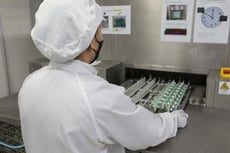 Ask who owns supplier performance and the approved vendor list; what happens when a component goes to allocation or end-of-life, and who qualifies the alternate; how inbound logistics, bonded warehousing and customs are handled; and what physically verifies incoming material before it reaches the line.
How SVI answers it
Supply chain management at SVI is a defined service rather than a purchasing function: supplier management and component lifecycle monitoring, alternate qualification, bonded warehousing, and fulfillment through third-party logistics, with CTPAT compliance covering US-bound freight. Behind it sits more than 25 years of component and supplier data, which is what makes incoming inspection risk-based — effort goes to the parts, suppliers and date codes with a history rather than being spread thinly across everything.
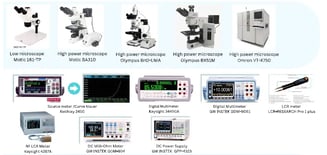
Material integrity is then verified physically rather than on paper. SVI’s failure analysis laboratory sits under supply chain management for exactly this reason: verifying authenticity, qualifying alternates before release, and establishing component-level root cause. Seven analytical techniques are available on site:
- Optical and X-ray inspection — microscopy from 7.5X to 1000X, 3D CT X-ray
- Chemical decapsulation — die-level access and die marking verification
- Elemental analysis — X-ray fluorescence, sodium through uranium
- Cross section analysis — solder joint, plating and interconnection inspection
- Electrical verification — curve tracer, LCR and RF LCR meters to 3 GHz
- Thermal analysis — thermal imaging and multi-channel data logging
- Mechanical and dimensional verification — vision measuring machine, force and strain gauges
 A reliability test laboratory on the same site qualifies alternates under environmental stress — temperature cycling, humidity, salt spray and solderability — so a part is released on evidence rather than on a datasheet comparison. Documented failure modes analyzed on site include counterfeit parts, ESD and EOS damage, silver sulfide corrosion, MLCC flex cracking, black pad, and BGA solder defects. Keeping this in-house removes days from a containment decision.
2. Can the partner take you from NPI to high volume without a handoff?
Many manufacturers are strong at one end of the lifecycle. Prototype houses build beautifully at low volume and stall at ramp. Volume factories quote attractively and have little appetite for the engineering iteration a new product needs. When a program has to move between the two, the transfer costs months of re-qualification, new test fixtures, and a fresh first-article process.
Ask two specific questions: who runs the NPI team, and what is the highest monthly output the site currently sustains for a product like yours?
How SVI answers it
SVI is built for high mix and high volume rather than treating them as a trade-off. New product introduction, design and development, and test development sit in the same organization as mass production, so a program moves from introduction to scaled output without changing partners. SVI’s fully automated line covers automated PCBA, front assembly, battery assembly and final assembly.
3. How deep does vertical integration actually go?
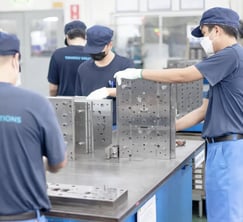 "Turnkey" and "one-stop" are used loosely. In practice they often mean the manufacturer coordinates purchasing from subcontractors on your behalf. That is a valid service, but it is procurement, not integration, and it does not remove the schedule risk of a third party missing a tooling date.
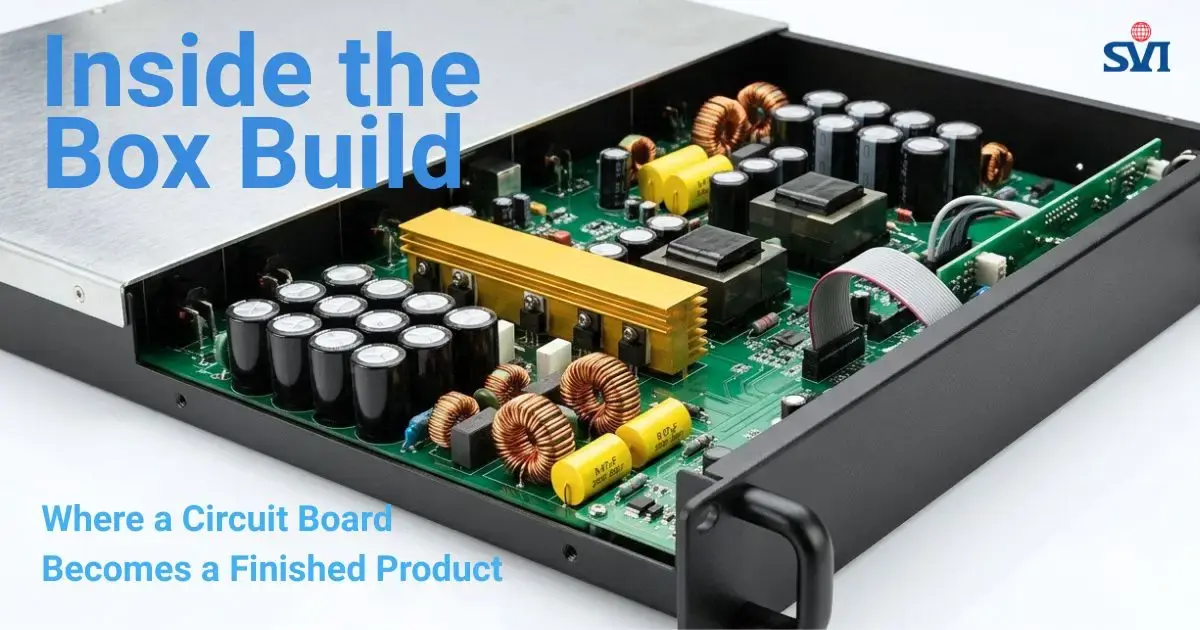
Ask which of the following are performed in-house, under the same management system: plastic injection molding, metal stamping, die and mold making, cable harness assembly, PCBA, box build, system build, and final packaging.
How SVI answers it
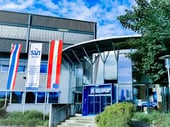
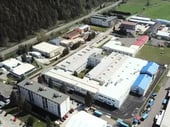
SVI Tohoku Solutions in Ayutthaya covers plastic injection, metal stamping, cable assembly, and die and mold making across a 45,000 square meter site, complementing PCBA and box build capacity at the Pathum Thani headquarters. A vertically integrated chain means the enclosure, harness, board, and final assembly are engineered and scheduled together rather than negotiated across three vendors. PCB manufacturing is being added at the Pathum Thani headquarters in 2026, extending that chain further upstream.
4. Who develops the test programs and fixtures?
Test is where quality claims are proven or quietly abandoned. If a manufacturer outsources test development, you inherit both the schedule risk of a third party owning your fixture dates and a knowledge gap on the floor: when yield drops during ramp-up, the engineers who set the limits are not the ones standing at the line.
Ask who writes the test program, who builds and maintains the fixtures, whether in-circuit and functional test are performed on site, and whether test results are recorded against the individual unit serial number rather than the batch.
How SVI answers it
Test development is an in-house service at SVI, covering in-circuit test and functional test program development and fixture design. Because the programs are written by the same organization that builds the product, a marginal reading or a test escape is investigated by the engineers who set the limits. Test results are linked back to the unit serial number, so a failing pattern can be correlated against process step, machine or material during NPI and ramp-up rather than after launch.
One distinction worth making: test development is not failure analysis. Test programs catch defects in production. Failure analysis explains why a component failed in the first place, and at SVI it belongs to supply chain management as a component risk capability — criterion one.
5. Can they trace a single unit back to its component lot?
Traceability is claimed universally and implemented unevenly. The difference shows up during a field issue, when the question is not "do you have records" but "how quickly can you tell me which units contain the affected component lot, and where they shipped."
Ask for a live demonstration. Give the manufacturer a serial number from a unit they built and time how long it takes to retrieve the full build history: component lots, operator, machine, process parameters, and test results at every stage.
How SVI answers it
Traceability at SVI runs on the Operation Control System, an internally developed platform that traces serialized units through every operation. Full loop tracing links component lot data, process parameters and test results to the individual unit, which converts a potential broad recall into a narrowly scoped containment action.
6. Is engineering support available in your language and time zone?
A design change that takes one phone call in your own language can take a week over email across a nine-hour gap. This is not a soft consideration; it directly affects engineering change order cycle time.
Ask where the engineers who will support your program sit, which languages they work in, and whether there is commercial support in your region who can reach them the same day.
How SVI answers it
SVI operates six manufacturing entities alongside sales and business development offices in Thailand, Cambodia, China, Denmark, Germany, Austria ,Slovakia and the United States, so European and North American programs have a commercial contact inside their own working day. Engineering support sits with the site that builds the product, which keeps the discussion with the people who can change something rather than with an intermediary. Japanese OEMs are covered by Japanese-speaking sales staff based in Japan who visit customers in person and sit within the SVI Tohoku Solutions team, so the commercial contact and the manufacturing site belong to the same organization rather than reporting to different managers.

.webp?width=170&height=128&name=Tohoku%20Solutions%20Facility%20(1).webp)


7. Is the site certified for your market — and can it be certified for what you need next?
Certification is granted to a facility, not to a corporation, so the length of a group’s combined list tells you very little. The question is narrower: is the site that will build your product certified for the market you sell into, and will that scope keep pace as your program changes. Breadth for its own sake is not a virtue — certifying every site to every standard carries audit cost that reaches the unit price, and says nothing about whether a site is good at the work you need.
Ask which certifications the quoting site holds and for the scope statements. Ask what workmanship standards apply across every site regardless of certification, because that is the floor your product is built to. Then ask what happens if your market later requires a certification the site does not yet hold.
How SVI answers it
SVI certifies each site to the markets that site serves. ISO 9001 is held across all six production sites; IATF 16949, ISO 13485, ISO 14001, ISO 45001, ISO/IEC 27001 and AS/EN 9100 are held according to each site’s scope, with the Pathum Thani headquarters carrying the fullest set including aerospace and medical device certification. Scope statements are available on request.
Beyond management systems, product workmanship standard and process compliance are covered by IPC-A-610, IPC-A-600, IPC J-STD-001, IPC-7711/21, and alongside with IPC/WHMA-A-620, FDA 21 CFR Part 820, VDA 6.3 and CTPAT where the market requires them. A board built at a newer site is built to the same workmanship standard as one built at headquarters; what differs is which third-party audits that site has been through, and that follows the markets it serves. Where a site is being positioned for a new market, certification is planned ahead of it — so a program that outgrows one market, or needs a second source in another region, does not have to leave the network to find a certified site.
8. If your manufacturing footprint needs to change, can the same partner build elsewhere?
Sourcing strategies change. Customers ask for regional supply, a market opens, a program needs a second qualified source. If that means finding a new manufacturer, you repeat the entire qualification cycle.
Ask whether the manufacturer operates other sites, whether those sites run the same quality management system and process documentation, and whether a product has actually been transferred between them.
How SVI answers it
SVI operates six production sites: Thailand headquarters in Pathum Thani (82,000 square meters, 25 SMT lines, 3,600 employees, 24/7 operation with a Class 10,000 clean room), Tohoku Solutions in Ayutthaya, Cambodia in the Phnom Penh special economic zone, Austria in Deutschlandsberg, Slovakia in Liptovský Hrádok, and the United States in Vancouver, Washington. One quality standard runs across the network, so a transfer is a qualification exercise rather than a new supplier search. Certification scope still differs by site, which is why criterion seven matters.
What scale tells you — and what it does not
Size is easy to compare and frequently misleading. SVI has more than 40 years of EMS experience since its founding in 1985, is ranked among the top 50 EMS providers worldwide, employs over 6,500 people and reported USD 574 million in revenue in 2025. Those figures establish stability. They do not tell you whether your program will get attention.
The more useful question is proportional: what share of the site’s capacity would your program represent, and who is the named engineering contact assigned to it? A program that is too small for a partner’s largest customers to notice is often exactly the program that gets the least engineering time. Ask the question directly, and ask for the answer in the quotation.
|
Key Takeaways
|
Frequently Asked Questions
What is a PCBA manufacturer?
A PCBA manufacturer assembles printed circuit board assemblies — populating bare boards with electronic components through surface mount technology and through-hole processes, then testing them. Full-service electronics manufacturing services providers extend beyond PCBA into box build, system build, cable harness assembly and final product fulfillment.
What is the difference between PCBA and box build?
PCBA is the populated and tested circuit board. Box build is the complete product: the board integrated with enclosures, cabling, displays, power supplies and mechanical components, tested as a finished unit and packed for shipment. Box build accounts for 73 percent of SVI’s revenue by product category, with PCBA at 22 percent.
Why do OEMs manufacture electronics in Thailand?
Thailand combines an established electronics supply base, a skilled engineering workforce, mature industrial infrastructure and long-standing trade access, which is why several global EMS providers operate high-volume sites there. For OEMs it offers scale and engineering depth in one location, with regional logistics access across Southeast Asia.
What is the difference between test development and failure analysis?
Test development builds the in-circuit and functional test programs and the fixtures that catch defects during production. Failure analysis explains why a component or a joint failed, and its main value to an OEM is component risk: verifying that a part is authentic, qualifying an alternate before release, and finding the mechanism behind a return rather than the symptom. They are separate capabilities with separate owners. Ask a prospective partner about each one.
What certifications should a PCBA manufacturer hold?
ISO 9001 is the baseline for any manufacturer. Beyond that, requirements are market-driven: IATF 16949 for automotive, ISO 13485 and FDA 21 CFR Part 820 for medical devices, AS/EN 9100 for aerospace, ISO/IEC 27001 where information security matters, and ISO 14001 and ISO 45001 for environmental and occupational safety management. Confirm each certificate names the site that will build your product.
How long does it take to qualify a new EMS partner?
For a typical industrial or communications product, expect three to six months from first quotation to qualified production, covering design for manufacturability review, prototype build, test development, first article inspection and process validation. Products in regulated markets take longer. A partner with in-house test development and new product introduction capability generally shortens the middle of that cycle.
Evaluating a manufacturing partner in Thailand?
SVI has manufactured electronics for global OEMs since 1985, across industrial and automation, communication and IoT, automotive and e-mobility, medical technology, aerospace, clean energy and AI data center infrastructure. Bring the eight questions above to a conversation with our engineering team and we will answer each one with documentation.
Talk to SVI about your program

 8
8