.png?width=64&height=64&name=artificial-intelligence%20(3).png)



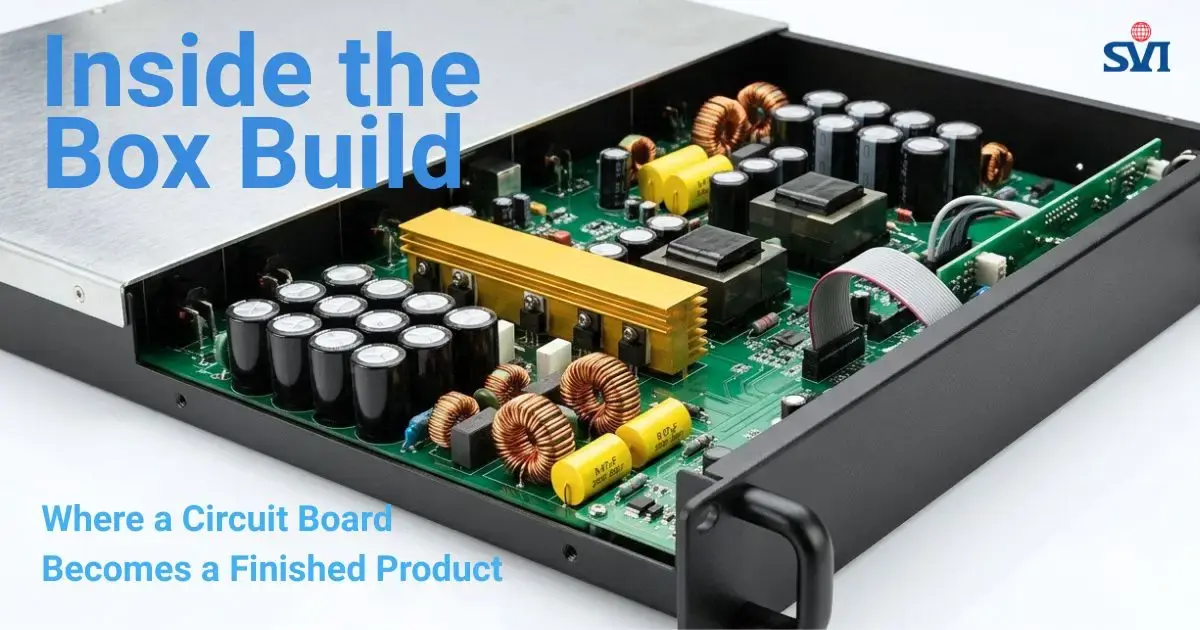
Box build assembly is the process of integrating populated circuit boards, cable harnesses, mechanical parts, and enclosures into a finished, tested product that is ready to ship. It sits one level above PCBA in the manufacturing chain. For an OEM, it means receiving a complete system from one partner instead of coordinating separate suppliers for boards, cables, plastics, and final assembly.
What is box build assembly?
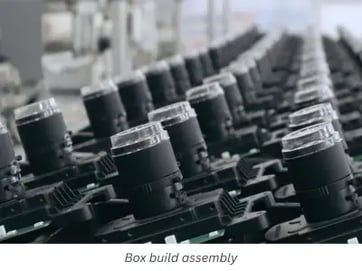 Box build, sometimes called systems integration or final assembly, covers everything that happens after the circuit board is populated and tested. The term is broad by nature. At the simple end, it can mean mounting a single board into an enclosure and packing it for shipment. At the complex end, it means integrating multiple sub-assemblies, wiring harnesses, displays, power supplies, and thermal management into a functioning system, then loading firmware, running system-level test, calibrating, serializing, and packaging the unit for direct delivery to the end customer.
That range is why the term causes confusion during sourcing. Two EMS providers can both offer box build and quote very different scopes of work. The practical takeaway for OEMs is to define box build scope explicitly in the RFQ rather than assume a shared definition.
What is included in a box build?
A typical box build scope includes some or all of the following:
- Mechanical assembly and enclosure integration, including fasteners, gaskets, and mounting hardware
- Cable and wire harness assembly, routing, and strain relief
- Integration of sub-assemblies such as PCBAs, displays, power supplies, sensors, and connectors
- Firmware loading, software configuration, and unit-specific parameter setting
- Functional and system-level testing of the assembled product
- Calibration and performance verification where the product requires it
- Serialization and traceability records linking every sub-assembly to the finished unit
- Final inspection, custom packaging, labeling, and shipment to regional distribution or the end customer
The last point matters more than it appears. When a manufacturing partner ships directly to distribution centers or end customers, the OEM removes an entire logistics stage and the inventory that sits inside it.
How is box build different from PCBA?
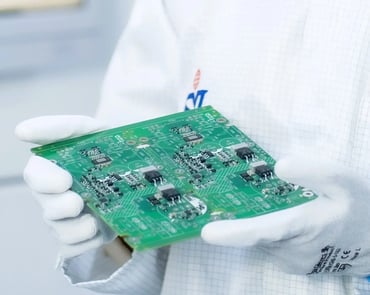 PCBA is the assembly of electronic components onto a bare printed circuit board through surface mount and through-hole processes, followed by electrical test. The deliverable is a board. Box build takes that board, adds everything else the product needs, and delivers a working system.
The difference that matters commercially is where the risk sits. In PCBA, risk concentrates in component-level process control: solder quality, component authenticity, placement accuracy, and test coverage. In box build, risk concentrates at the integration stage. Tolerance stack-up between mechanical parts, connector seating and retention, cable routing near heat sources, and gaps in system-level test coverage are the issues that surface late and cost the most to correct.
This is also where multi-supplier models break down. When a finished unit fails final test, and the board came from one supplier, the harness from another, and the enclosure from a third, establishing root cause becomes a negotiation rather than an engineering exercise. A single manufacturing partner responsible for the complete assembly removes that ambiguity.
When does an OEM need a box build partner?
Most OEMs arrive at box build for operational reasons rather than technical ones. The common signals include:
- Coordinating five or more suppliers to produce a single finished product
- No clear owner when a quality problem crosses supplier boundaries
- Recurring defects that appear only at the integration stage, not at incoming inspection
- Engineering and procurement teams spending more time on supplier management than on product development
- Long coordination cycles delaying new product introduction
- Expansion into new regions that requires final assembly closer to the customer
- Product complexity growing faster than the internal operations team can absorb
Startups and scale-ups feel this earliest, because they rarely have the headcount to run a distributed supply chain. Established OEMs reach the same point from the other direction, when product variants multiply and the coordination burden grows faster than volume.
What should OEMs look for in a box build manufacturer?
Six capabilities separate a genuine box build partner from a contract assembler.
System-level test capability. Board-level in-circuit and functional test are necessary but not sufficient. Ask what test the partner performs on the assembled unit, and whether they can develop test programs and fixtures for your product rather than only run yours.
Mechanical and industrialization engineering. Box build problems are frequently mechanical. A partner with in-house tooling, fixture design, and mechanical engineering resolves those issues during industrialization instead of during production.
Serialized traceability. Every sub-assembly, component lot, and process step should be traceable to the individual finished unit. This is what makes containment precise and field investigations fast, and it is increasingly a customer requirement rather than a differentiator.
Component risk management. Constrained parts, obsolescence, and authenticity concerns are managed through structured alternate qualification and component-level root cause analysis, supported by failure analysis capability. This is distinct from test development, and OEMs should confirm both exist.
Certification scoped to your market. Automotive, medical, aerospace, and industrial products carry different compliance requirements. What matters is whether the site building your product holds the certifications your market requires, not the size of the group certification list.
Volume scalability. A partner that supports prototype and low-volume introduction but cannot scale to high-volume production forces a transfer later, and every transfer carries cost and risk. The right question is whether the same partner can take the product from introduction through to full-rate production.
Why does vertical integration matter in box build?
Every supplier interface in a box build is a handoff, and every handoff is a point where schedule, quality, or accountability can be lost. Vertical integration reduces the number of interfaces.
When plastic injection molding, metal fabrication, cable assembly, and die and mold tooling sit inside the same manufacturing group as PCBA and final assembly, engineering changes propagate in days rather than weeks. Tolerance issues between a molded housing and a populated board get resolved by two teams in the same organization. There is one owner for the finished product and one set of quality records behind it.
For OEMs, the measurable effects are shorter introduction cycles, fewer integration defects, and a single point of accountability when something goes wrong.
Box Build at SVI
Box build represents 73 percent of SVI's revenue, making it the core of what we do rather than a service added alongside PCBA. Over more than 40 years as an electronics manufacturing services provider, we have built complete systems for communication and IoT, industrial and automation, automotive and e-mobility, audio video and security, medical, aerospace, and AI data center infrastructure customers.
Our six production sites across Thailand, Cambodia, Austria, Slovakia, and the United States combine engineering-led new product introduction with high-volume mass production capability. That combination is deliberate. It allows customers to move from prototype to full-rate manufacturing, including automated lines running more than 600,000 units per month, without changing partners. In-house plastic, metal, cable, and tooling capability supports the mechanical side of complex box builds, and serialized traceability runs across the full assembly.
If you are evaluating whether to consolidate a distributed supply chain into a single box build partner, we can walk through your product structure and identify where the integration risk actually sits.


 8
8