


.png?width=64&height=64&name=artificial-intelligence%20(3).png)




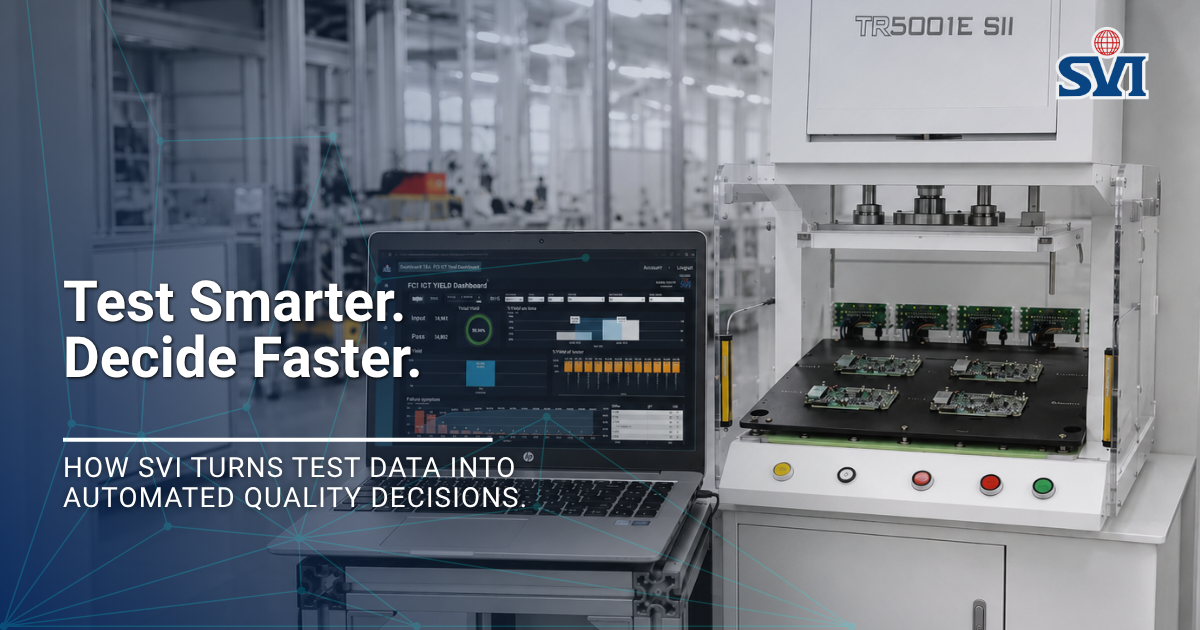
In electronics manufacturing, test engineering is often understood as a quality gate — a checkpoint that separates conforming products from non-conforming ones. But this framing underestimates what modern test engineering can do when it is fully integrated with a live traceability and data system.
At SVI, our test engineering capability has evolved beyond pass/fail verification into an active quality intelligence infrastructure. In this episode, we share how SVI’s test engineering team has deployed advanced ICT and FCT technologies — alongside our OCS (Operation Control System) traceability platform and real-time data systems — to drive automated quality decisions, standardize performance across our global plants, and give customers direct visibility into their own production quality.
ICT: Raising the Speed and Precision of Electrical Verification
In-Circuit Test (ICT) is the first electrical verification stage in PCB assembly — checking for shorts, opens, missing components, and incorrect passive values before a unit is powered up. Throughput and accuracy at this stage have a direct impact on overall line efficiency and downstream quality.
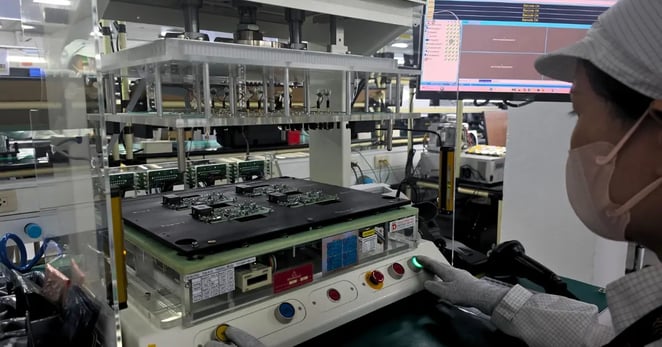
SVI’s test engineering team has invested in an advanced ICT platform that represents a significant capability step beyond conventional ICT equipment. Where a standard ICT machine tests one PCB at a time, SVI’s current ICT infrastructure tests four PCBs simultaneously — delivering up to 4x the throughput of conventional ICT equipment without compromising test coverage or accuracy.
This parallel testing capability is particularly valuable in high-volume production environments, where ICT can become a bottleneck if throughput is not matched to upstream assembly rates. By eliminating that constraint, SVI’s test engineering team ensures that ICT operates as a high-speed quality filter rather than a production chokepoint.
Equally important is the software layer. Rather than relying on vendor-supplied test programs out of the box, SVI develops ICT software in-house — giving the team precise control over test logic, coverage parameters, and diagnostic output. For customers requiring close collaboration, SVI partners with their engineering teams to align ICT coverage with their specific production and quality standards.
|
ICT Capability Highlights
|
FCT: From Pass/Fail Logging to Real-Time Quality Intelligence
Functional Circuit Test (FCT) validates that an assembled unit performs its intended function under simulated operating conditions. Unlike ICT, which tests component-level electrical integrity, FCT evaluates the product as a system — making it the primary functional verification stage before shipment.
FCT also generates the richest data of any test stage. Every test cycle produces structured results across multiple functional parameters, and over time, those results form a dataset that can reveal patterns no single test event would surface on its own. The critical question is whether that data is being captured, stored, and acted upon — or simply logged and left idle.
At SVI, FCT data is fully integrated into our OCS (Operation Control System) and a dedicated database infrastructure that feeds real-time dashboard visualization. This means that FCT results are not archived for periodic review — they are live, queryable, and connected to automated monitoring logic from the moment each test cycle completes.
This system supports two distinct user environments:
- SVI internal teams access yield dashboards, process performance trends, and automated alerts that flag anomalies against established quality baselines — enabling continuous, automated process monitoring with real-time alerts and reducing reliance on manual reporting.
- Customers with integration requirements can connect via SVI’s secure customer portal to view their own production data in real time for independent analysis, process verification, and quality assurance reporting.
The FCT system also supports command and control functions — meaning that data insights can trigger production actions directly, not just inform manual decisions after the fact. Yield dashboard generation, automated shift reporting, and historical log retention are standard capabilities within the platform.
|
Illustrative Scenario: FCT Failure Triggering Automated Disposition A unit reaches the FCT station and fails a power supply regulation check. The OCS system responds immediately:
Total time from failure detection to system-wide hold: in near real-time (typically within minutes) — with no manual intervention required. |
OCS Traceability: Closing the Loop Across Every Process Step
 The foundation that makes automated quality decisions possible is SVI’s OCS traceability system — a platform that traces every unit through every process step, by part and by product, from incoming components to finished goods shipment.
OCS implements what we describe as Full Loop Tracking: a closed traceability model that SVI configures in alignment with each customer’s specific process flow, ensuring that the traceability logic reflects their production requirements rather than a generic template. This has two critical operational consequences.
First, it prevents process skipping. If a unit attempts to advance to a downstream station without completing a required upstream step — whether an ICT test, a visual inspection, or a programming stage — OCS flags the anomaly and halts progression. This eliminates the risk of non-conforming units bypassing quality gates undetected.
Second, it ensures that test results from every stage — including ICT and FCT — are stored against each unit’s serial record in a structured, queryable format. This means that when a quality issue emerges, the investigation does not require manual record retrieval. The full history of every affected unit is immediately accessible, including which components were used, which operators handled the unit, and what results were recorded at every test station.
The result is 100% traceability for every serialized unit through the in-line production flow — end-to-end, with a complete and unbroken data chain.
|
OCS Traceability: Core Capabilities
|
Global Standardization: One Quality Standard Across Every SVI Plant
One of the more significant engineering challenges in a multi-site Electronics Manufacturing Services (EMS) operation is maintaining consistent quality standards across geographically distributed plants. Different equipment generations, varying local practices, and the complexity of customer-specific requirements can all create quality variability that is difficult to detect until it surfaces as a production issue.
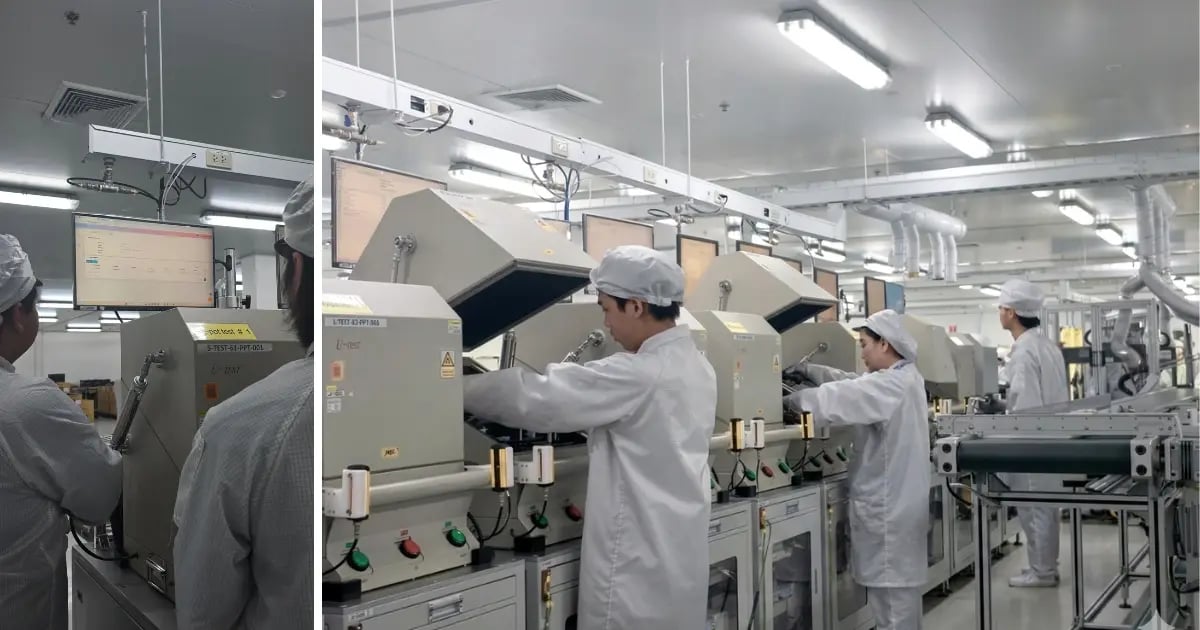
SVI’s test engineering team addresses this directly. The ICT and FCT platforms, OCS traceability system, and data infrastructure described in this article are not isolated implementations at a single site — they are deployed and actively maintained across SVI Thailand, SVI USA, and SVI’s global production plants. Test engineering standards, traceability logic, and data visibility tools are harmonized to the same framework across the entire network.
For customers with production distributed across multiple SVI sites, this consistency is operationally significant. It means that a product manufactured in Thailand and a product manufactured at another SVI facility are subject to identical test coverage, identical traceability requirements, and identical quality data standards. Customers can apply the same analysis methodology to data from any SVI plant — with consistent measurement and recording standards across sites.
This global alignment is not incidental — it is the result of deliberate investment by SVI’s test engineering team in shared platforms, standardized deployment practices, and ongoing cross-site coordination to keep quality infrastructure consistent as technology evolves.
|
Key Takeaways
|
This episode concludes SVI's four-part series on traceability in intelligent manufacturing. Across these articles, we have explored how traceability data is captured, structured, and acted upon — from incoming components through ICT and FCT testing to the automated quality decisions that protect every unit leaving our production lines.
The systems described in this series — OCS traceability, parallel ICT testing, real-time FCT dashboards, and closed-loop quality workflows — are not aspirational. They are operational today across SVI's global manufacturing network, serving customers in aerospace, defence, industrial, and high-reliability electronics sectors who require complete, auditable quality visibility as a baseline, not an option.
If your programme has traceability requirements that your current EMS partner is not meeting — or if you are evaluating partners for a new production transfer — we would welcome the conversation.
|
Ready to See Traceability in Action? Whether you are evaluating test engineering capability or looking for an EMS partner that delivers end-to-end quality visibility — SVI's team is ready to discuss your requirements. |
Traceability in Intelligent Manufacturing — Full Series
Episode 1 · The Hidden Accelerator Behind Faster Time to Market
Episode 2 · Component-to-Serial Traceability — Building the Data Foundation for Automation
Episode 3 · Process-to-Serial Traceability: Enabling Automated Quality Control
Episode 4 · From Traceability Data to Automated Quality Decisions ◀ You are here

 7
7
.webp)


