


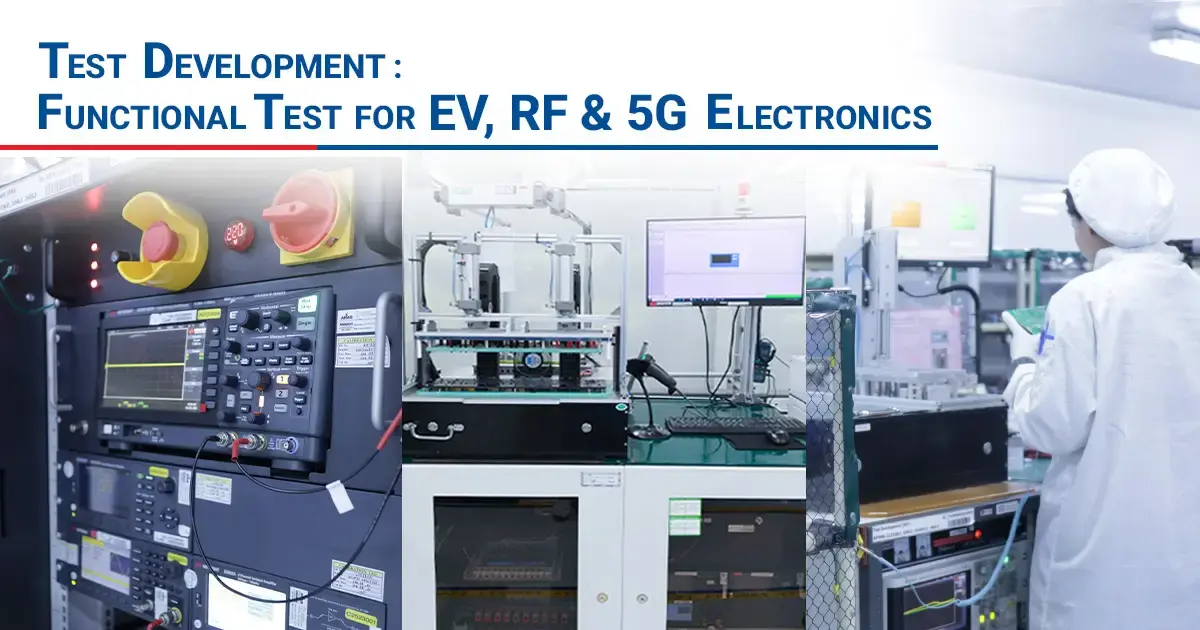
A battery management system (BMS) for an electric vehicle (EV) and a 4,000-watt audio amplifier both get a functional test before they leave the factory. Almost nothing else about those two tests is the same.
The BMS tester simulates well over a hundred battery cells, talks to the board over CAN and checks high-voltage insulation. The amplifier tester measures gain, frequency response and distortion a human ear would never pick up. Put either product on the other's tester and you'd learn nothing useful.
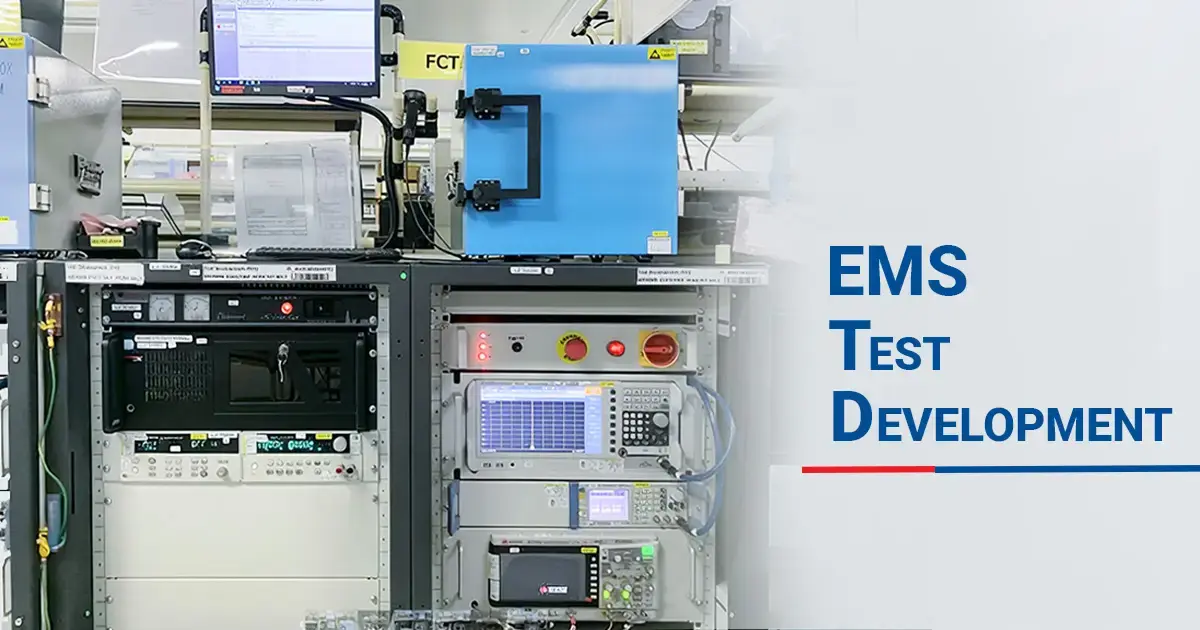
In Episode 1 EMS Test Development, we explained why functional test (FCT) is where SVI's Test Development team brings its deepest expertise: there is no off-the-shelf FCT, so every tester has to be engineered for the product it checks. This episode shows what that looks like in practice, using testers the team has built since 2023
|
Key takeaways
|
The product decides the test
In-circuit testing asks roughly the same question of every board: is each part there, is it the right value, and is it connected correctly? Functional test asks something else. Does this product do its job? The answer depends entirely on what the job is.
That's why every project starts with the customer's test specification rather than a catalog of equipment. The specification says what the product must do. The team decides how to prove it, unit after unit, and designs the tester around that answer.
"Every new product brings unique testing challenges, especially with the increasing complexity of EV, RF, and 5G technologies. At SVI, our Test Development team starts by understanding the product's critical functions and customer requirements, then designs a tailored test solution to ensure reliable test coverage, measurement accuracy, and production readiness."
— SVI Test Development team
Here's what that looks like on five very different products.
EV battery management systems: precision and high-voltage safety
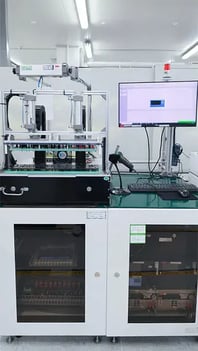
A BMS looks after an EV's battery pack. It monitors cell voltages and temperatures, balances charge between cells and protects the pack when something goes wrong. A small measurement error, repeated over years of charging, can shorten battery life or create a safety risk. The end-of-line test has to prove the board measures and reports correctly before it goes anywhere near a vehicle.
SVI's Test Development team has built testers for both the cell monitoring unit (CMU), which sits close to the cells, and the battery management unit (BMU), which makes the decisions. The end-of-line tester brings together:
- Battery simulators instead of real cells. Real cells drift, age and store a lot of energy. Programmable battery simulators covering well over a hundred cell channels give every input a precise, repeatable voltage.
- Independent measurement. Data acquisition units check the BMS readings against a known reference.
- CAN communication. A BMS that measures correctly but can't report to the vehicle has still failed, so communication is tested alongside measurement.
- High-voltage insulation testing. A hipot and insulation resistance tester is part of the station. In an EV, isolation between high-voltage and low-voltage circuits is a safety requirement.
- Changeable fixtures. One station handles several master and slave board variants by swapping the fixture, not rebuilding the tester.
RF devices: measuring signals you can't see
An RF board can pass every visual and electrical check and still transmit at the wrong power, drift off frequency or interfere with other equipment. None of that shows up without a functional test and the right RF instruments.
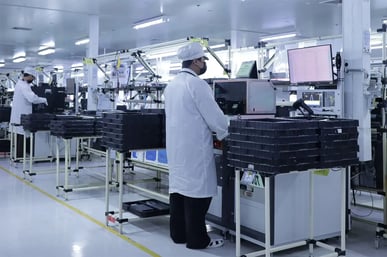
Take a wireless device with two antennas, one of the RF testers the team has developed. Its station combines:
- An RF shield box, so phones, Wi-Fi and other signals on the factory floor stay out of the measurement and the device's own signal stays in.
- RF probes positioned on each antenna, with coaxial switching to route each signal path to the instruments.
- RF instruments from Rohde & Schwarz, including a signal generator and spectrum analyzer, working alongside Keysight data acquisition, power supply and oscilloscope.
Every cable, switch and probe in that path loses a little signal. Getting a reading you can trust, on every unit, depends as much on the fixture and signal routing as on the analyzer itself.
GPS trackers: four radios on one small board
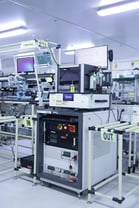 A GPS tracker looks simple from the outside. The one the team built a tester for carries four radio functions inside: LTE-M and GSM cellular across low and high bands, Bluetooth Low Energy, and satellite positioning on GPS and GLONASS. Each has its own antenna, its own frequencies and its own ways to fail.
- No sky indoors. A GNSS simulator feeds the tracker a known satellite signal, so positioning can be checked on the line instead of out in the parking lot.
- Output power on every radio. Transmit power at each antenna port is measured with a power sensor that spans 1 nW to 2 W, wide enough for a Bluetooth signal and a cellular transmission on the same station.
- Shielded testing. The tracker is tested inside an RF shield box, so the result reflects the product, not the factory around it.
- Programming built in. Where a product needs it, firmware programming can be integrated into the test fixture, so a board is programmed and tested in one pass.
5G network equipment: timing, ports and everything a technician touches
5G networks depend on very precise timing, and much of it comes from satellite signals. The network equipment the team built a tester for handles that timing, alongside high-speed data ports and a front panel of LEDs, buttons and service ports. All of it has to work.
The tester checks:
- Power consumption, using a programmable AC source
- High-speed SFP+ ports, using electrical loopback modules
- The GNSS timing antenna input, using a GPS simulator
- Serial, Ethernet and USB ports, alongside a known-good reference unit
- LEDs, read by a camera with image processing rather than an operator's eye
- Buttons, pressed by pneumatic actuators so every unit gets the same press
Audio power amplifiers: measuring what people hear
The amplifiers the team tests range from 80 watts up to 4,000 watts. Listening is not a production test: ears get tired, and two people will hear the same unit differently. So the tester measures instead:
- Level and gain
- Frequency response
- Distortion (THD and THD+N) and signal-to-noise ratio
An Audio Precision APx515 analyzer does the audio measurement. SVI-designed relay control, switching and multiplexed DC voltage measurement route signals between the analyzer and the many test points on the fixture.
More than these five
These testers are examples of the team's recent work, not the limit of what it can test. Its toolbox includes, among others:
- Power: DC and AC supplies, isolated three-phase power and electronic loads
- High-voltage safety testing: AC/DC hipot, insulation resistance, ground bond and impulse
- RF signal generation, analysis and power measurement
- Communication protocols including CAN, LIN, RS-232, RS-485, RS-422, I2C, SPI, Modbus, Profibus, HART, Bluetooth and LAN
- Precision measurement, waveform generation and waveform analysis
- Machine vision for LEDs, 7-segment and LCD displays, color and pattern matching
- IC programming for microcontrollers and memory devices, offline or built into the test fixture
Instruments come from established suppliers such as Keysight, Rohde & Schwarz, Chroma, Audio Precision, Tektronix and National Instruments. The toolbox grows with every new product the team takes on.
Different products, one way of building testers
Underneath, all of these testers are built the same way. Fixtures are designed in SolidWorks. Relay and switching boards are designed by SVI. Test software is developed on platforms such as NI LabVIEW, TestStand and Python. Results are logged in text, Excel, XML or JSON and stored on SVI's server, the customer's server, or both.
That shared foundation is what lets a tester developed at SVI Thailand (HQ) run the same way at Tohoku Solutions, SVI Cambodia, SVI Austria, SVI Slovakia or SVI USA. When a product moves between sites, or is built in more than one region, the test method moves with it.
"In today's fast-paced electronics industry, time-to-market is just as important as test quality and reliability. At SVI, our end-to-end in-house Test Development capabilities allow us to execute multiple engineering activities in parallel, respond quickly to product challenges, and accelerate test solution development to meet our customers' project timelines without compromising test coverage or measurement accuracy."
— SVI Test Development team
Talk to us about your test strategy
Working on an EV, RF, connected or audio product, or something else entirely? Share your test specification and schematic with us at quotation stage, and SVI's Test Development team will propose a functional test approach built around what your product has to do. No test specification yet? The team can propose one.
Learn more about SVI Test Development or contact our team.
FAQ
1. Why does functional testing differ so much between products?
Because functional test checks what a product does, and every product does something different. A BMS has to measure and protect, a GPS tracker has to find its position and connect, an amplifier has to sound right. Each needs its own fixture, instruments and software.
2. How is an EV battery management system tested without real batteries?
SVI's BMS testers use programmable battery simulators that present precise, repeatable voltages to every cell input. That's safer than connecting real cells and lets the tester set exact test conditions.
3. Why are RF products tested inside shield boxes?
Production floors are full of radio signals. A shield box keeps them out of the measurement and keeps the device's own signal contained, so results reflect the product and not its surroundings.
4. Which communication protocols can SVI's testers handle?
The team works with a wide range, including CAN, LIN, RS-232, RS-485, RS-422, I2C, SPI, Modbus, Profibus, HART, Bluetooth and LAN, and adds new ones as products require.
5. Can SVI develop a functional tester for a product type not listed here?
Yes. Each tester is engineered from your test specification, schematic, Gerber files, layout data and golden units, whatever the product.
6. Can a tester developed in Thailand run at other SVI sites?
Yes. Testers are built on common SVI frameworks and deployed across SVI's manufacturing sites in Thailand, Cambodia, Austria, Slovakia and the USA, so test methods stay consistent wherever a product is built.


 9