


Test Development Series — Episode 1 of 4
A board that passes on the line but fails in the field costs far more than any test ever will — in warranty claims, in rework, and in the trust of your own customers. A tester that isn’t ready when mass production starts costs time you can’t get back.
That’s why, when OEMs evaluate an electronics manufacturing services (EMS) provider, one question deserves more attention than it usually gets: who engineers the tests that prove your product works?
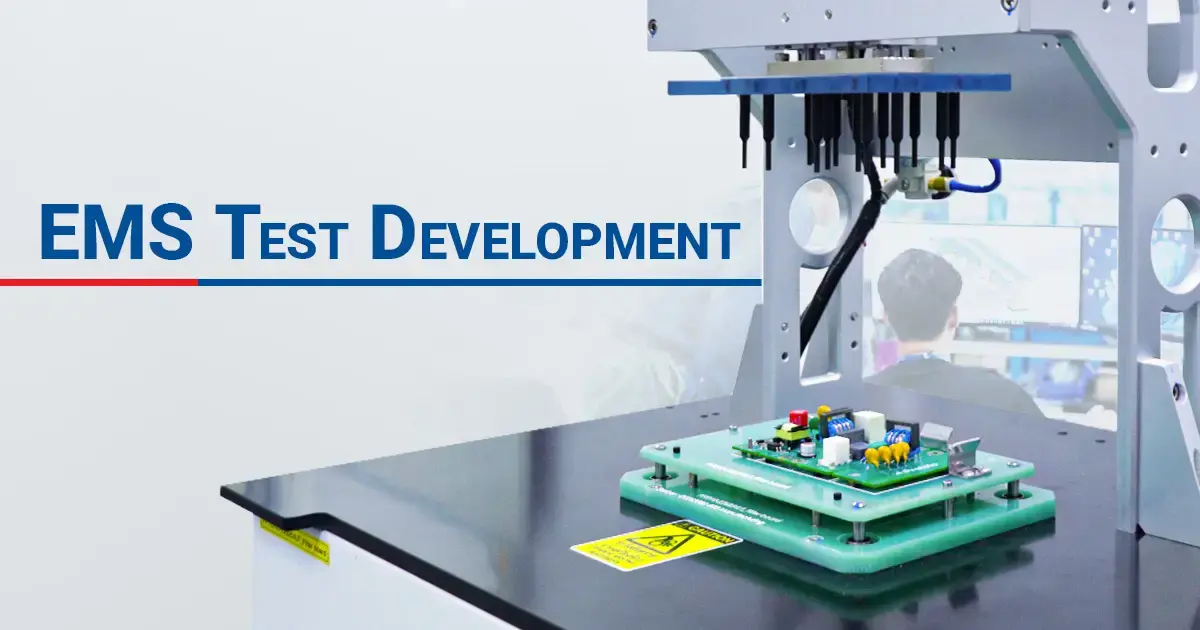
At SVI, the answer is our own Test Development team. Based at SVI Thailand (HQ) in Pathum Thani, the team designs and builds complete test solutions — test hardware, test software and mechanical test fixtures — for customers’ PCBAs and finished products, and deploys them across SVI’s global manufacturing network.
In this first episode of our Test Development series, we explain what EMS test development is, what it changes for your product, and how to get the most out of it.
|
Key takeaways
|
What is EMS test development?
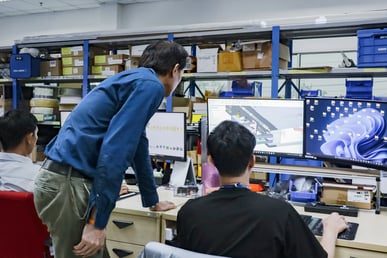 Test development is the engineering behind production testing. It starts with a decision — how should this product be tested? — and continues through the design of the fixtures, instruments, switching and software that carry out those tests on the production line, board after board.
“We design and build the test machines and software that check every board and product works correctly before it leaves the factory — so customers receive reliable products, problems are caught early, and production keeps running.”
— SVI Test Development team
Running tests vs. developing them: why the difference matters to you
Many OEMs still treat testing as the last step before shipment rather than something planned alongside the design. When test strategy arrives late, the consequences are predictable: a slower ramp-up, gaps in test coverage, and defects found by your customers instead of on the line.
Developing tests in-house, rather than only running them, affects how quickly an EMS partner can respond when something changes.
“An EMS partner that develops its own tests is less dependent on outside vendors. It can shorten tester development, speed up NPI and production ramp, implement engineering changes without waiting for suppliers, and recover a failed tester quickly to help minimize production downtime.”
— SVI Test Development team
What in-house test development means for your product
- Get to market faster — testers are developed alongside your NPI build, reducing reliance on external test vendors.
- Respond to engineering changes faster — ECOs, test program updates and production fixes are handled by the same team that built the tester.
- Keep your product knowledge protected — your design data, test algorithms and calibration methods aren’t passed to third-party test houses.
- Get consistent results wherever you build — common test frameworks for FCT, ICT and automation keep methods aligned across SVI sites.
- Minimize production disruption — in-house test engineering enables faster troubleshooting, test-system recovery and implementation of engineering changes, helping minimize production disruption.
The right test for every stage of your product
There is no single “best” test. Flying probe testing supports early builds and design changes, while fixture-based testing delivers the faster cycle times needed for high-volume production. These are complementary stages in one manufacturing strategy, and choosing the right method at each stage is a core part of test development.
|
Method |
Role in the manufacturing strategy |
|
Flying probe |
Early builds and design changes, before moving to fixture-based testing as the design stabilizes |
|
MDA |
High-volume PCBA production |
|
ICT |
High-volume PCBA production |
|
FCT |
Final proof the board or product works as designed — custom-engineered for each product |
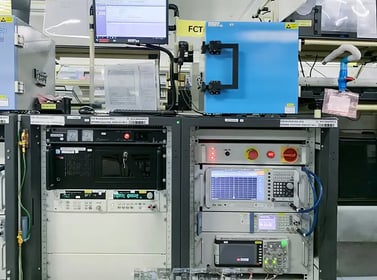 |
| RF Tester Development |
Used together, these methods take a product from product introduction to mass production within one EMS partner: flexible, fixtureless testing while the design is still evolving, then high-coverage, high-speed fixture-based testing as production scales to high volume — high mix and high volume, without changing partners along the way.
Test capabilities, proven on demanding products
 SVI’s Test Development team covers the full scope of test development — from Design for Test (DFT) at the design stage to test hardware, test software and complete test stations — so one team supports your product from design review to volume production.
What sets us apart is Functional Test (FCT). Flying probe and ICT are well-established methods across the EMS industry — they confirm a board was built correctly. Functional test answers the question your customers care about: does the product work? There is no off-the-shelf FCT. Every product powers up, communicates and behaves differently, so every functional tester must be engineered for that product — fixture, switching, instrumentation and software. This is where SVI’s Test Development team brings its deepest expertise.
Our test development capabilities include:
- Functional testing (FCT) — our core strength
- Design for Test (DFT): testability review of schematics and board layouts, with recommendations on test points, test access and programming interfaces before the design is frozen
- In-circuit testing (ICT) and manufacturing defect analysis (MDA) for high-volume PCBA production
- Flying probe testing for early builds and design changes, complementing fixture-based testing in volume production
We’ll explore these in the next episodes.
Engineered in-house, end to end
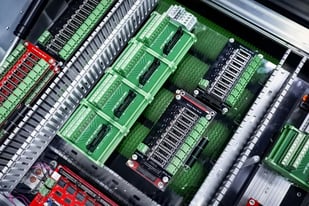
Our FCT systems are engineered entirely in-house. Every element of an SVI tester is engineered by the team. Single- and dual-access pneumatic test fixtures are designed in SolidWorks — and can be built in a changeable style, so one tester handles several board variants. Test software is developed in NI LabVIEW and TestStand. Complete test stations are integrated in-house, combining SVI-designed relay and switching boards with instrumentation from established suppliers such as Keysight, Rohde & Schwarz, Chroma and Audio Precision.
Your test data, your way. Results are logged in text, Excel, XML or JSON format and stored on SVI’s server, your server, or both — giving you a clear, reviewable test record.
How a test development project works
A typical engagement follows five steps, with clear inputs from you and clear deliverables from us:
- Requirements — you share the test specification, schematic, Gerber files, board layout data (ODB++ preferred) and golden units.
- Build — we source the test equipment, then design, assemble and wire the fixture.
- Software — we develop the main test program, including vision routines where needed.
- Integration and release — hardware and software are integrated and fine-tuned with your golden board, and log files are shared with you for approval.
- Documentation — you receive the BOM, spare parts list and user manual.
Development lead time depends on equipment lead times and test system complexity, so we agree a milestone plan with you at quotation stage.
Bring test in early: what it changes
Our strongest advice to OEMs is simple: involve test development early, ideally at quotation stage. The biggest reason is Design for Test (DFT) feedback. When our test engineers review your design before it’s frozen, they can flag issues such as missing or inaccessible test points, components that block probe access, or circuits that are hard to isolate, while changes are still easy and inexpensive. A design with good DFT leads to a better product, and it makes the test fixture simpler, more reliable and more cost-effective to build.
Early involvement also speeds up planning. With your test specification and schematic, the team can decide how to test and which equipment is needed. With layout data, it can design and price the fixture.
Consistent testing across SVI’s global network
Test systems are developed at SVI Thailand (HQ) and deployed to SVI manufacturing sites including Tohoku Solutions (Thailand), SVI Cambodia, SVI Austria, SVI Slovakia and SVI USA. Team engineers support installation and commissioning on site — in 2025, for example, they installed and commissioned testers at SVI Slovakia.
Because every tester is built on common frameworks for FCT and ICT, your test methods stay consistent wherever your product is built. That matters most when a product is transferred between sites, or produced in more than one region to serve customers closer to home.
Already building with SVI?
The same Test Development team that supports new programs is here for the products you already build with us. Talk to your SVI account team if you’re planning to:
- Implement an engineering change that needs a test program or fixture update
- Scale up volumes and move from flying probe to fixture-based ICT for faster cycle times
- Add test coverage — for example, new functional, RF or vision checks
- Transfer or duplicate production at another SVI site with the same test methods
- Launch a next-generation product — the earlier we see the design, the more we can help
Make test strategy part of your product plan
“Investing in the right test strategy early brings shorter time-to-market, faster issue resolution, less production downtime, and stronger confidence in every product shipped.”
— SVI Test Development team
Launching a new product, or moving an existing one to a new manufacturing partner? Share your test specification and schematic with us at quotation stage. We’ll build a test approach around your requirements for every stage, from first prototypes to full-volume production. No test specification yet? Our team will propose one for you
Already an SVI customer? Your account team can bring the Test Development team into your next engineering change, volume ramp or product transfer.
Learn more about SVI’s Test Development service at SVI Test Development or contact our team.
FAQ
1. What is EMS test development?
It is the engineering behind production testing: choosing how a product should be tested, then designing the fixtures, instruments, switching and software that run those tests on the production line.
2. What is the difference between ICT and FCT?
In-circuit testing (ICT) checks individual components and connections on a PCBA using a bed-of-nails fixture. Functional testing (FCT) checks that the board or finished product works as designed — power, signals, RF, audio, communications and visual indicators.
3. Why is FCT SVI’s strength?
ICT and flying probe are widely available across EMS providers. Functional test must be engineered from scratch for each product, and that takes in-house hardware, fixture and software expertise. SVI’s Test Development team designs and builds complete FCT systems in-house and deploys them across SVI’s global sites.
4. How do flying probe testing and ICT work together?
Flying probe testing needs no dedicated fixture, so it supports early builds while the design may still change. Once the design is stable, fixture-based ICT provides the faster cycle times and high coverage needed for high-volume production. They are complementary stages that take a product from NPI to mass production.
5. What do I need to provide to start?
The test specification, schematic, Gerber files, board layout data (ODB++ preferred) and golden units.
6. Does SVI develop test software as well as fixtures?
Yes. SVI’s Test Development team designs fixtures, develops test software in NI LabVIEW and TestStand, and integrates complete test stations in-house.
7. Can the same tests be used at different SVI sites?
Yes. Testers are built on common frameworks for FCT, ICT and automation and deployed across SVI’s manufacturing sites in Thailand, Cambodia, Austria, Slovakia and the USA, so test methods stay consistent wherever a product is built.


 12