.png?width=64&height=64&name=artificial-intelligence%20(3).png)



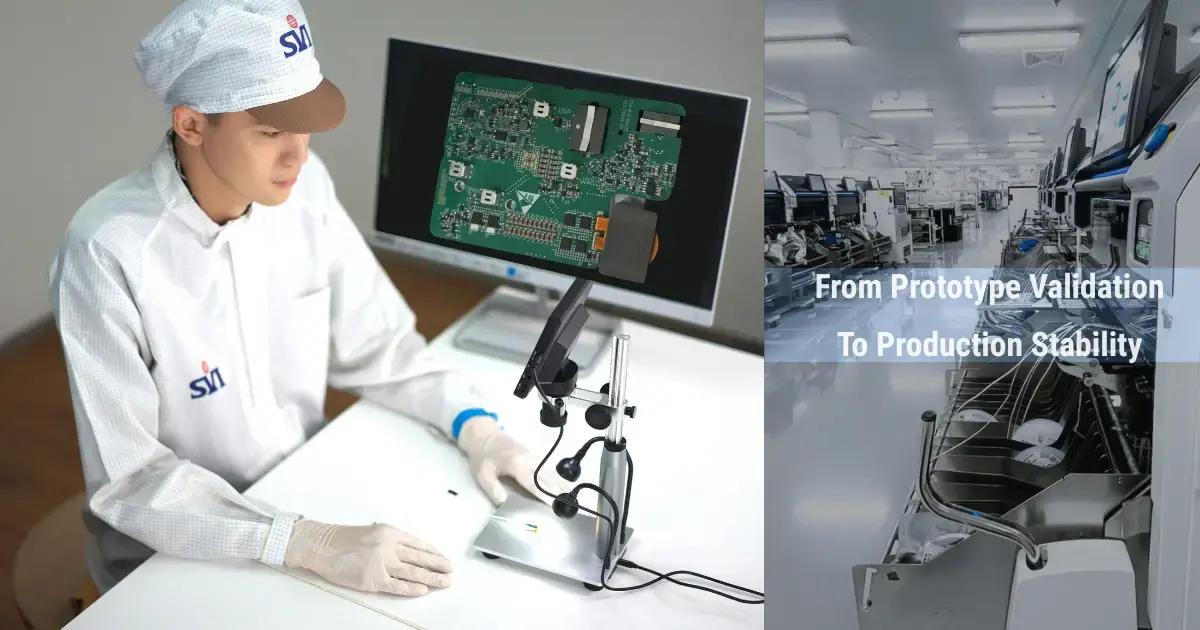
As AI infrastructure expands globally, OEMs supporting power delivery, thermal management, and cooling systems are under increasing pressure to scale manufacturing rapidly and consistently across regions.
The first prototype passes validation. Power consumption remains within specification. Thermal performance meets target expectations. The NPI team signs off.
But the real challenge is only beginning.
For OEMs developing critical electronics that support AI infrastructure, validating a design is only the first milestone. The greater challenge begins when the product must transition into stable, high-volume manufacturing across multiple sites while supporting aggressive deployment schedules tied to hyperscale expansion programs.
This is often the stage where manufacturing programs either accelerate successfully — or expose the operational gaps between prototype capability and true global production readiness.
While AI compute platforms often receive the most industry attention, the surrounding infrastructure ecosystem is equally critical. High-density AI deployments depend heavily on reliable power conversion, thermal management, cooling, and supporting control electronics operating continuously under demanding conditions.
As global AI infrastructure investment continues to scale, the ability to manufacture these systems consistently across regions has become a strategic requirement for OEMs supporting hyperscale deployment programs.
NPI and Mass Production Are Fundamentally Different Problems
NPI is fundamentally an engineering challenge. Mass production, however, is an operational systems challenge. The disciplines required are closely connected — but they are not the same.
During NPI, the objective is to validate that a design can be manufactured successfully. Engineering teams work through unknown variables including process parameters, test coverage, yield drivers, and material behavior under real production conditions. The environment is controlled, the team is focused, and rapid iteration is expected.
During mass production ramp-up, the objective shifts toward consistency and scalability. The manufacturing process must repeatedly deliver the same output across multiple lines, shifts, suppliers, and often multiple global sites. Decisions made during NPI become long-term process controls that the broader production system must maintain consistently.
For power conversion and thermal management electronics supporting AI infrastructure, this transition introduces several critical operational risks:
- High-power components — including switching FETs, gate drivers, high-frequency capacitors, and bus bars — require extremely tight placement and soldering discipline that becomes more difficult to sustain when scaling from controlled NPI builds into full SMT production environments.
- Thermal performance validated during prototype builds can shift once broader process variation enters production. A temperature margin that appears stable across 50 units may narrow significantly across several thousand units.
- Power and thermal systems supporting AI environments operate continuously under high-load conditions. Reliability expectations therefore align more closely with industrial-grade infrastructure than conventional consumer electronics.
NPI validates the product design. Ramp-up validates the manufacturing system behind it.
What Typically Goes Wrong in the NPI-to-Ramp Transition
Most manufacturing programs that struggle during ramp-up do not fail because of poor product design. They struggle because process knowledge, operational discipline, and supply chain readiness do not transfer effectively from the NPI environment into full production.
Process Knowledge That Lives in People, Not Documents
NPI engineers naturally develop deep product-specific insight during development. They understand which solder paste volume is actually required for a particular pad geometry, how a board behaves during reflow, and which test sequences identify meaningful failures. When this knowledge is not formally embedded into work instructions, control plans, and production documentation, manufacturing teams inherit operational gaps that only surface during ramp-up.
Supply Chain Constraints That Appear Only at Volume
Components available during prototype builds can quickly become constrained once production volumes increase. For critical AI infrastructure electronics, this creates significant operational risk. High-current MOSFETs, precision inductors, thermal interface materials, and specialized power-management ICs frequently operate under extended lead times and limited approved vendor availability. Without proactive supply chain coordination, these constraints are often identified after production commitments are already in place.
Yield Issues That Only Surface at Scale
Defect modes that remain invisible during a 50-unit NPI build often emerge once production reaches several thousand units. Process variation previously absorbed through intensive engineering attention becomes visible as a major yield driver at full production rate. Without strong traceability infrastructure implemented from the beginning, root-cause analysis becomes dependent on manual investigation, slowing corrective action and extending the overall learning curve.
Multi-Site Knowledge Transfer
When NPI is executed at one site and production transfers to another — or across multiple global locations — the transfer becomes only as effective as the engineering package supporting it. If process documentation, traceability structures, and control systems are incomplete, the receiving site effectively restarts the learning cycle, increasing yield risk and extending deployment schedules.
A Case Study: Dual-Site NPI and Cross-Continental Production for Critical Infrastructure Electronics
A leading OEM engaged SVI to manufacture power inverter electronics supporting AI infrastructure deployment. The program required simultaneous NPI activity at SVI Thailand and SVI Electronics USA, followed by coordinated mass production and cross-site operational integration.
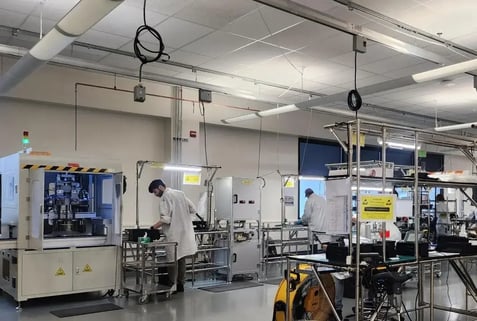 |
| NPI production activities at SVI USA |
Dual-Site NPI: Building in Parallel, Not in Sequence
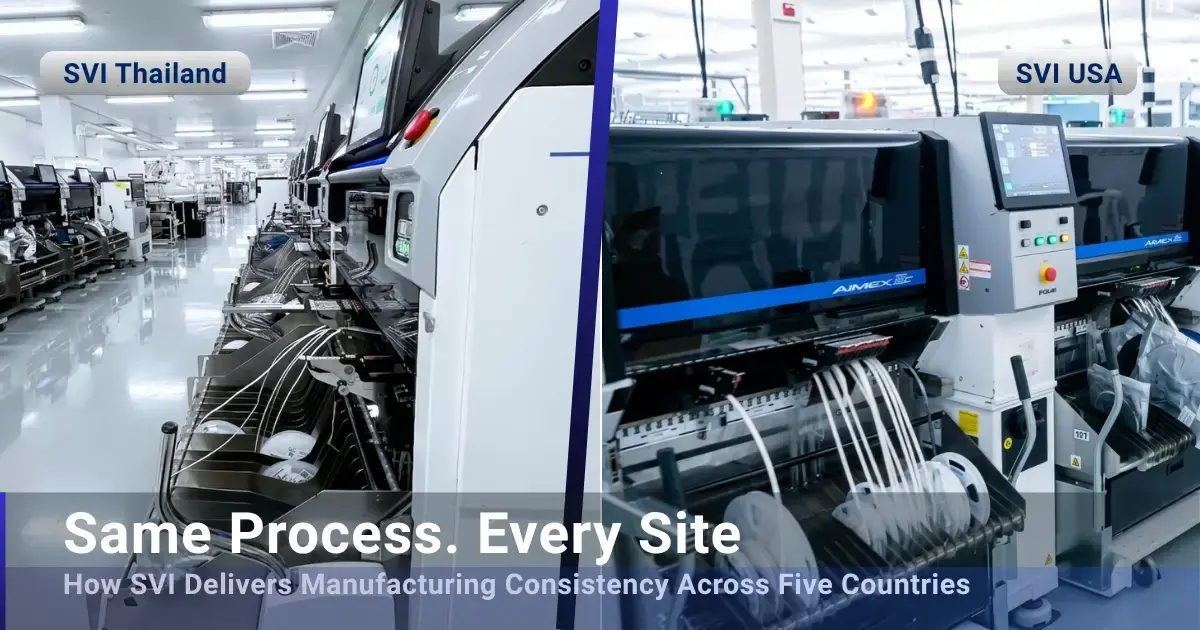
NPI activities were executed concurrently at SVI Thailand and SVI Electronics USA. Rather than completing NPI in one region and repeating the learning cycle later at another site, both facilities operated from a common engineering baseline with aligned process documentation, standardized test specifications, and the same traceability framework.
When process findings emerged at either location, they were evaluated against the shared baseline and incorporated into both manufacturing environments before mass production began. This allowed engineering learning, process optimization, and production readiness activities to progress in parallel rather than sequentially.
The result was a ramp-up process built on validated manufacturing knowledge, structured process control, and operational alignment across both regions.
Global Manufacturing Coordination for Critical Infrastructure Electronics
Mass production of PCBAs was established in Thailand, leveraging SVI’s high-volume manufacturing scale, engineering depth, and supply chain infrastructure. Finished PCBAs were then shipped to SVI Electronics USA for box-build assembly, system-level integration, final testing, and customer delivery preparation.
This manufacturing model allowed the OEM to balance operational efficiency with localized customer support. It leveraged Thailand’s manufacturing scale and cost structure while maintaining customer-facing integration and deployment coordination within the United States.
Traceability as the Connective Thread
Throughout the program, component-to-serial traceability was maintained from incoming inspection in Thailand through final box-build completion in the USA.
Every PCBA carried a complete digital build record including component lot information, process parameters, inspection history, and final test results accessible across both manufacturing sites.
For critical electronics supporting always-on AI infrastructure, traceability is not simply a reporting function. It becomes the operational backbone enabling faster root-cause analysis, stronger corrective action discipline, improved containment capability, and reduced operational disruption.
What This Model Requires from an EMS Partner
Executing a program involving dual-site NPI, cross-site production, and continental manufacturing coordination requires more than standard EMS capability. It demands strong operational alignment, disciplined engineering transfer systems, and globally consistent execution.
- A common quality management system operating consistently across all manufacturing sites.
- Structured digital NPI transfer discipline that minimizes dependency on verbal handovers and extended on-site support.
- Supply chain infrastructure capable of coordinating sourcing, alternate qualification, and inventory positioning across multiple regions simultaneously.
- Unified program management accountability rather than isolated site-level execution models.
- Traceability systems capable of maintaining uninterrupted manufacturing data continuity across inter-site transfers.
SVI’s global manufacturing network, developed across more than 40 years of EMS operations, is structured around these operational principles. The Thailand–USA program reflects the same manufacturing model supporting customers across Thailand, Austria, Slovakia, and Cambodia.
What Good Ramp-Up Looks Like for AI Infrastructure OEMs
For OEMs supporting AI infrastructure, a successful NPI-to-ramp transition depends on far more than production volume. It requires manufacturing systems capable of maintaining engineering discipline, traceability integrity, operational consistency, and supply chain stability while scaling globally.
- Yield improves systematically during early production because traceability data actively supports corrective action and process optimization.
- Engineering changes introduced during ramp-up are absorbed with minimal disruption because change-management systems were established during NPI.
- Supply chain constraints are minimized because alternate sourcing strategies and component qualifications were addressed before full-scale production began.
- OEM deployment schedules remain achievable because manufacturing readiness was treated as a critical program requirement from the beginning.
These outcomes are not accidental. They are the result of manufacturing discipline intentionally designed into the program from the earliest NPI stages.
As AI infrastructure deployment accelerates globally, OEMs increasingly depend on manufacturing partners capable of scaling critical power, thermal, cooling, and supporting electronics without compromising quality systems, traceability, or operational consistency across regions.
SVI’s multi-site manufacturing model is designed around this requirement.
From NPI through global ramp-up, the objective remains consistent: helping OEMs scale critical infrastructure electronics with the engineering discipline, manufacturing control, and operational reliability required for high-availability AI environments.
Planning your next ramp-up program for critical AI infrastructure electronics?
Talk to SVI’s engineering team about multi-site manufacturing strategies for power, thermal, cooling, and supporting infrastructure systems.

AI DATA CENTER SERIES NAVIGATION
← EP 2: Supply Chain Resilience for AI Data Center Infrastructure mini-series
→ EP 4: Managing Product Lifecycle Across Regions (upcoming)


 8
8