.png?width=64&height=64&name=artificial-intelligence%20(3).png)




Data Center EP 2: Supply Chain Resilience for AI Data Center Infrastructure mini-series part 4
The Promise Behind a Multi-Site Network
A multi-site manufacturing network can reduce supply chain risk. But one critical question remains: are all sites truly equivalent?
Geographic diversification helps mitigate disruption. It does not automatically guarantee consistency—and for AI infrastructure OEMs, that distinction matters. Power management boards, cooling control systems, and thermal monitoring assemblies are built to exacting specifications. A resilient supply chain that introduces quality variation is not a solution; it is simply a different form of risk.
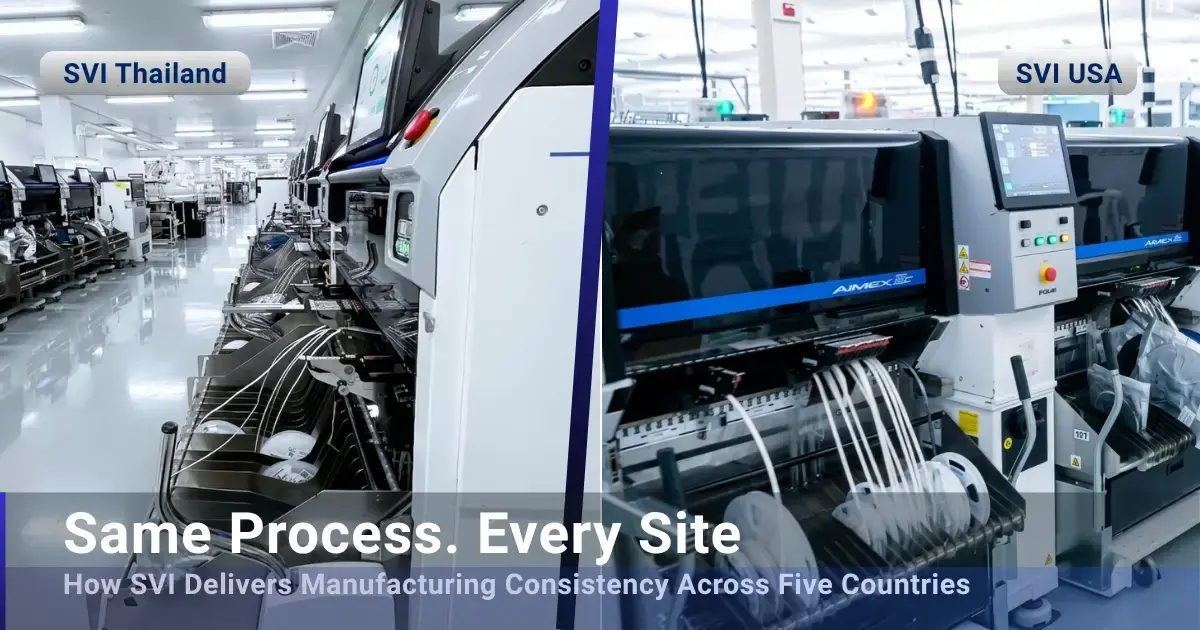
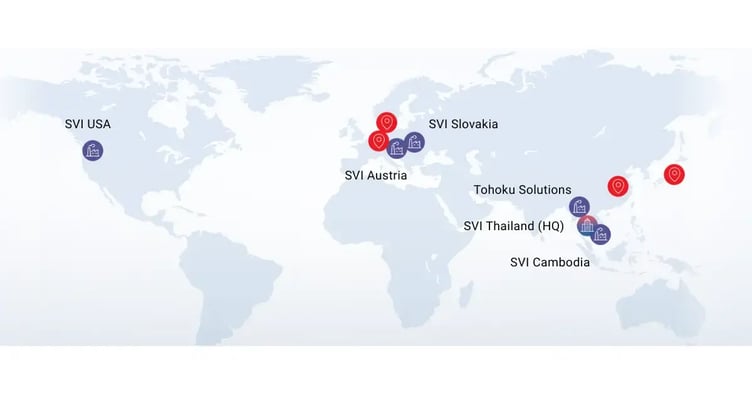
This is how SVI maintains one provable quality standard across production sites in Thailand, Cambodia, Austria, Slovakia, and Washington, USA.
Why Multi-Site Manufacturing Often Creates Variation
When an OEM approves a single factory, they are approving a known operating environment: defined equipment, trained personnel, and validated processes. Quality becomes linked to a specific location.
When production expands to a second or third site, those assumptions can change. Equipment calibration, local supply sources, workforce training history, and execution methods may differ. Even with strong controls, variation can emerge—and in high-reliability electronics, variation is where failures begin.
This is why many OEMs remain cautious when evaluating multi-site EMS partners. The resilience advantage is clear, but the validation effort and risk of hidden process drift are trade-offs procurement and quality teams weigh carefully.
SVI’s answer to this challenge is architectural, not reactive.
One Process, Replicated—Not One Factory, Duplicated
SVI does not replicate factories. It replicates a manufacturing process.
Group-wide engineering standards define process requirements with a level of precision that limits site-by-site interpretation. Solder profiles, inspection criteria, test coverage thresholds, traceability protocols, and quality checkpoints are established at group level and implemented consistently across all sites.
An engineer in the United States works from the same framework as an engineer in Thailand. Equipment may vary by location, but where common platforms are used—such as SMT lines in Thailand and the U.S.—configurations follow identical operating standards.
This model is reinforced by cross-site engineering capability. SVI’s Thailand engineering team, with more than 40 years of manufacturing experience, supported the setup of four SMT production lines at SVI USA, helping transfer proven know-how, process discipline, and operational readiness across regions.
This is the foundation of true multi-site consistency.
The Role of Traceability in Proving Consistency
Standards can be documented. Compliance must be demonstrated.
SVI’s OCS traceability system operates across all production sites, capturing data at three levels: work order quantity, serial-to-reel component tracking, and inspection image records.
Every unit carries a complete and retrievable manufacturing history—which machine was used, which component lot was installed, what inspection result was recorded, and at which site production took place.
Critically, OCS creates comparable data structures across all locations. An OEM reviewing records from Thailand and Washington, USA sees the same data logic, the same checkpoints, and the same traceability depth.
Consistency therefore becomes more than a claim—it becomes independently verifiable.
Group-Wide Certification: Qualifying a Process, Not Just a Factory
SVI manages certification as a group discipline through shared internal audit frameworks, common corrective action systems, and cross-site quality reviews designed to identify systemic improvement opportunities.
In practical terms, this changes the economics of OEM expansion. Adding a second SVI site for volume growth, regional compliance, or risk diversification does not mean restarting from zero.
The manufacturing process is already known. The operating standards are already validated. The traceability structure is already familiar.
That is what it means to qualify a process, not just a factory.
What This Means for AI Infrastructure OEMs
Three market realities make this model especially relevant to the AI data center sector.
Faster Deployment Timelines
AI infrastructure programs move quickly. An EMS partner that can shift production between qualified and equivalent sites—without major revalidation delays—provides meaningful schedule flexibility when demand accelerates.
Regional Manufacturing Requirements
Regulations and procurement preferences increasingly influence where electronics must be produced. SVI’s European operations in Austria and Slovakia, combined with its North American presence in Washington, USA, help OEMs align regional sourcing strategies without changing suppliers.
Uncompromising Field Reliability
OEMs cannot accept quality variation between production batches of AI data center electronics. Process control, traceability, and standardization are no longer differentiators—they are baseline expectations.
The real question is which EMS partners can consistently prove them.
Closing: The Series in Full
This series began with a simple reality: the electronics powering AI data centers are foundational, not peripheral.
Parts 2 and 3 explored the supply chain pressures reshaping sourcing decisions and introduced SVI’s six-site network as a structural response to regional concentration risk.
This final chapter answers the next logical question: are those sites equivalent?
Yes—the process is standardized, the traceability is consistent, and the certification framework is group-wide.
For AI infrastructure OEMs evaluating electronics manufacturing partners, that combination is what real supply chain resilience requires.
🔎 Key Takeaways
- Every SVI production site operates under the same group-wide engineering standards — solder profiles, inspection criteria, test thresholds, and traceability protocols are set at group level, not site level
- SVI's OCS traceability system captures identical data structures across all sites — quality records from Thailand and Washington, USA are directly comparable, making consistency independently verifiable
- Where common equipment platforms are used — such as SMT lines in Thailand and the U.S. — configurations are held to identical operating standards, supported by direct knowledge transfer from SVI's Thailand engineering team; expanding to a second site for volume, regional compliance, or risk distribution does not require re-qualification from zero
- Qualifying SVI means qualifying a process, not just a factory — OEMs gain access to a proven, standardized manufacturing system across five countries, not a collection of independently managed facilities
Looking for a scalable, high-reliability EMS partner for AI data center electronics?
Contact SVI to discuss your next program: https://www.svi-hq.com/contact-us


 4
4