.png?width=64&height=64&name=artificial-intelligence%20(3).png)




How proactive control of materials and suppliers supports faster, more reliable product launches
In today’s competitive electronics industry, OEMs face increasing pressure to commercialize products faster—without compromising reliability or compliance. But as designs grow more complex and supply chains span multiple regions, maintaining control over thousands of components becomes one of the most critical factors that influence launch timelines.
Many OEMs plan their time-to-market strategy around design readiness and manufacturing capacity. Yet in reality, the biggest delays often stem from issues hidden much earlier: component quality, sourcing visibility, supplier performance, and lack of transparency across the material flow.
As a world-premier EMS provider, SVI sees a clear pattern:
OEMs that prioritize end-to-end component control achieve faster, smoother, and more predictable product launches.
Below is a strategic guide on why this control matters and how it sets the stage for traceability.
1. The Real Bottleneck: Component Complexity, Not Manufacturing Capacity
Modern electronic products rely on hundreds—or even thousands—of components. Each one must arrive with correct specifications, proper documentation, and assured authenticity.
But when visibility is limited, OEMs often encounter challenges such as:
- receiving materials that do not match design intent
- inconsistent quality across lots
- unverified suppliers or alternative sources
- electrical deviations detected late in build
- rework from wrong or mismatched components
Any one of these issues can halt an entire production line.
The result: launch delays, unexpected costs, and extended debugging cycles.
End-to-end component control ensures that every part used during NPI and mass production meets expectations—reducing risk before the first unit is even built.
2. Early Material Issues Create Major Time-to-Market Delays
When a component problem appears during pilot builds, validation builds, or ramp-up, it creates a chain reaction:
- Investigation
- Root-cause analysis
- Containment
- Supplier response
- Rework or redesign
- Additional testing
- Rescheduling the build
What should be a 2-day issue turns into a 2-week delay.
Strong component control minimizes this risk by:
- verifying suppliers upfront
- validating components before usage
- maintaining consistency across builds
- reducing surprises during test and qualification
%20(1).webp?width=553&height=219&name=Counterfeit%20parts%20management%20%201%20(1)%20(1).webp)
For OEMs targeting tight production windows, early prevention is far more efficient than late correction.
3. Counterfeit and Misrepresented Components Are a Growing Threat
Global shortages and parallel sourcing channels increase the risk of receiving:
- remanufactured components
- re-marked parts
- recycled ICs
- substitutes with different electrical behavior
Even when such parts appear “functional,” they can cause:
- inconsistent test results
- high failure rates
- reliability issues months after deployment
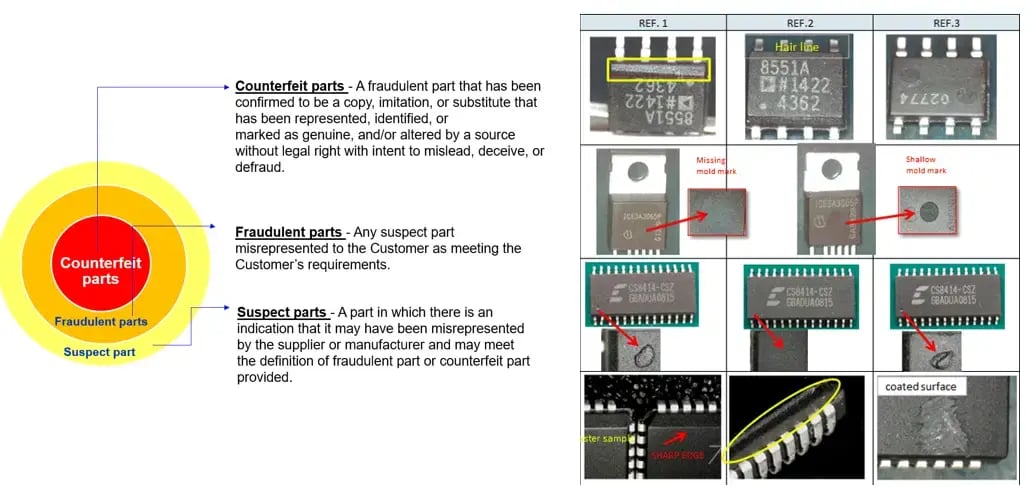
Preventing these risks requires disciplined component control and supplier qualification—not just inspection at the production line.
This is where a strong EMS partner becomes a key asset to OEM success.
4. NPI Success Depends on Component Stability Across Every Build Stage
During NPI, the goal is to learn, refine, and stabilize the product. But when components vary from one build to the next, OEMs face:
- fluctuating yields
- inconsistent failure modes
- unpredictable performance
- delays in validation and certification
To accelerate time-to-market, OEMs need component stability—consistency across EVT, DVT, PVT, and mass production.
That stability is only possible when there is full control over:
- sourcing
- quality
- supplier reliability
- material verification
- change management
This ensures that what gets tested is identical to what will be mass produced.
5. Supplier Reliability Directly Impacts Launch Timelines
A strong supplier ecosystem protects OEMs from last-minute surprises such as:
- unexpected lead-time changes
- unapproved substitutions
- inconsistent lot performance
- incorrect documentation or certificates
When suppliers are not fully qualified and monitored, OEMs often experience delays in the final weeks of NPI—precisely when timing matters most.
By partnering with an EMS provider that maintains a disciplined supplier management process, OEMs benefit from higher stability and predictable material flow.
6. Component Control Creates the Foundation for Traceability
Once OEMs understand the complexity and risk within the component supply chain, a natural question arises:
How can we gain continuous visibility, control, and accountability throughout the entire manufacturing process?
The answer—and the next step—is traceability.
Traceability provides:
- visibility into every component’s origin
- proof of material authenticity
- history of each production step
- direct linkage between materials, processes, and test results
- rapid containment when issues occur
In other words, traceability is what transforms component control into real operational speed and reliability.
This is why traceability is the logical continuation of this topic.
Conclusion: Faster Time-to-Market Starts With Early Component Control
For OEMs, accelerating time-to-market is not only about efficient assembly—it begins far earlier, with disciplined control over every component that enters the product.
When material visibility, supplier quality, and component authenticity are managed proactively, OEMs gain:
- fewer surprises during NPI
- faster debugging cycles
- higher build consistency
- lower risk of field failures
- smoother transition to mass production
And with this foundation in place, traceability becomes the powerful next layer—enabling true speed, transparency, and reliability from the first build to full-scale production.



 8
8