.png?width=64&height=64&name=artificial-intelligence%20(3).png)




Powering and Cooling AI at Scale: The Electronics Behind Critical Infrastructure
AI Data Center Series — Episode 5
When people talk about the AI infrastructure buildout, the conversation almost always centers on GPUs. Processing power, chip architecture, model scale. But every AI GPU cluster depends on a layer of hardware that rarely makes headlines: the power distribution systems, conversion electronics, uninterruptible power supplies, cooling control boards, and monitoring assemblies that keep it all running.
This is where the real infrastructure challenge lives. And it is where electronics manufacturing expertise becomes mission-critical.
The Hidden Challenge of AI Infrastructure
Modern AI training clusters are drawing 10 to 100 times the power density of conventional server environments. A single GPU rack can consume 30–60 kW—and next-generation configurations are pushing well beyond that. This creates compounding demands across the entire facility stack.
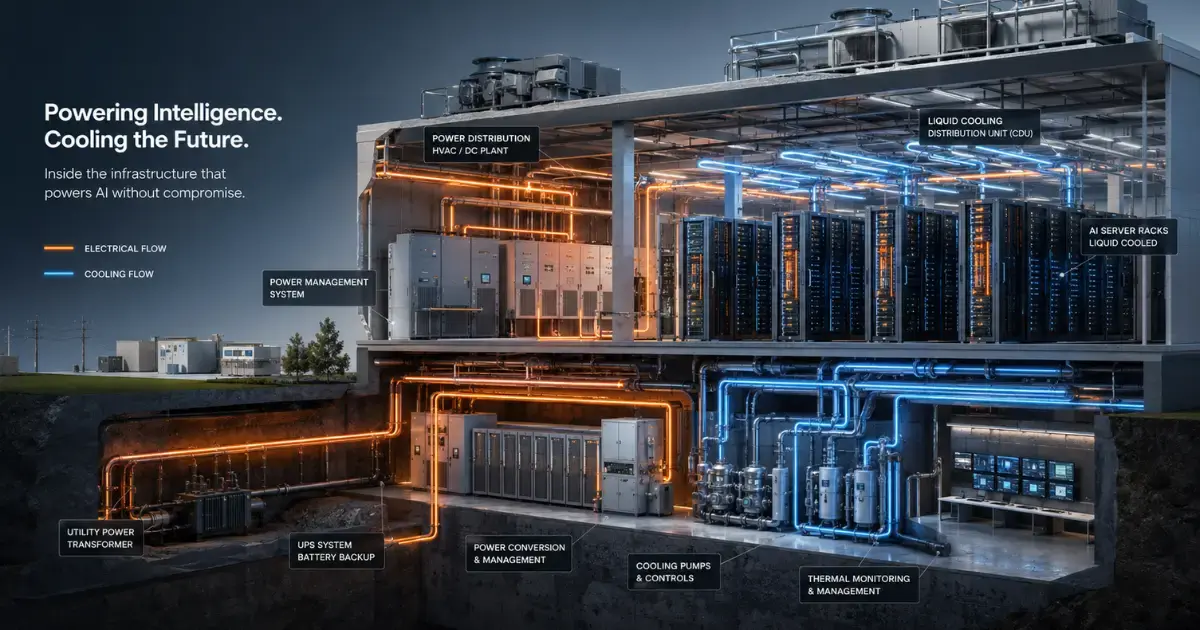
Every GPU rack depends on:
- Power distribution electronics that route high-current loads reliably
- Power conversion assemblies that manage voltage regulation at scale
- UPS electronics that protect against any interruption
- Thermal management electronics that govern liquid and air cooling systems
- Monitoring and control boards that provide real-time infrastructure visibility
None of this infrastructure runs itself. Behind every one of these systems is a set of electronics assemblies — boards, controllers, sensors, drive modules — that must perform without failure in high-heat, high-current, continuous-uptime environments. That is the manufacturing challenge that defines this market.
Power Electronics: The Backbone of AI Data Centers
Power infrastructure is the largest and most technically demanding category in AI data center electronics. It is also where manufacturing quality has the greatest consequence: a failure in power distribution or conversion can take an entire rack offline.
Intelligent PDU Electronics
Modern intelligent PDUs are not passive distribution hardware. They contain controller boards, current sensing modules, and monitoring electronics that provide per-outlet visibility, remote switching capability, and load management. The PCBAs inside these units operate at high current densities and must maintain accuracy across continuous operating cycles. Tight tolerances in component placement, solder joint integrity, and thermal performance are non-negotiable.
UPS Electronics
Uninterruptible power supplies for AI infrastructure carry some of the strictest reliability requirements in the electronics space. The control electronics, power management boards, and monitoring assemblies inside UPS systems must perform flawlessly at the moment of a grid disturbance — by definition, a moment with no margin for error. Manufacturing these assemblies to IPC Class 3 standards, with full traceability through every production step, is the baseline requirement.
Power Conversion PCBAs
Power conversion assemblies are among the most complex PCBAs in the data center environment. They handle high-current loads, generate significant heat, and must maintain conversion efficiency across a wide operating range. The manufacturing process requires careful management of component sequencing, thermal interface materials, and post-assembly validation. For AI applications, where power efficiency directly affects operating cost at scale, performance consistency across production runs is a commercial imperative.
SVI’s experience manufacturing power management electronics — including assemblies for energy systems that demand continuous high-current performance and precise regulation — reflects the process depth this product category requires. The traceability infrastructure, thermal validation protocols, and multi-site production capability developed across these programs translate directly to the demands of AI infrastructure power electronics.
Busbar and Power Management Assemblies
Busbar assemblies and power management modules handle the physical routing of high-current power within racks and facilities. Their manufacture requires precision in conductor sizing, connection integrity, and mechanical fit. Combined with embedded monitoring electronics, these assemblies form the physical and digital backbone of data center power architecture.
Cooling Systems Depend on Electronics Too
The data center cooling conversation has shifted decisively toward liquid. Direct-to-chip cooling, rear-door heat exchangers, and immersion systems are moving from pilot installations to standard deployment at hyperscale facilities. Air cooling alone cannot keep pace with the thermal output of current GPU architectures.
What often goes unaddressed in that conversation is this: none of these cooling systems function without electronics.
SVI manufactures the electronics that enable cooling systems — not the cooling systems themselves. That distinction matters because it defines where EMS manufacturing expertise applies. The pump drive assemblies that regulate coolant flow, the sensor boards that monitor temperatures across hundreds of data points, the flow monitoring electronics that detect anomalies in real time, and the thermal control PCBAs that govern system response — these are precision electronics products with the same reliability requirements as power infrastructure.
For OEMs developing liquid cooling solutions for AI deployments, the manufacturing challenge is significant. These assemblies operate in environments with vibration, condensation risk, and continuous thermal cycling. Component selection, conformal coating, and assembly process discipline are not optional considerations.
Monitoring Infrastructure: The Intelligence Layer
A third category is emerging as a distinct product family in AI data center infrastructure: monitoring and control electronics. As facilities scale, the complexity of managing power draw, thermal conditions, and system status across thousands of components requires dedicated monitoring hardware.
This includes infrastructure management boards that aggregate sensor data across a facility, control systems that automate responses to thermal or power events, and monitoring electronics embedded within PDUs, UPS units, and cooling assemblies. These products combine high-reliability PCBA manufacturing with firmware integration requirements, making them a natural fit for an EMS partner with intelligent manufacturing capability.
Why Manufacturing Quality Is the Differentiator
Readers who have followed this series will recognize these themes. Episodes 2 through 4 covered SVI’s approach to traceability, supply chain integrity, NPI execution, and product lifecycle governance. For power and cooling electronics specifically, those capabilities are not differentiators in a general sense — they are the entry conditions.
IPC Class 3 manufacturing standards define the baseline for mission-critical electronics. Full component-level traceability enables rapid field investigation if an issue arises in deployed infrastructure. Thermal validation at the assembly level catches failure modes before they reach the field. High-mix production capability allows OEMs to bring complex, low-to-medium volume products to market without the cost structure of a dedicated factory.
What changes at the product level is the specificity of these requirements. Power conversion PCBAs generate heat that must be modeled and validated. UPS control boards must pass rigorous functional testing under simulated failure conditions. Pump drive assemblies need vibration qualification. The manufacturing process must be engineered around the product, not the other way around.
Scaling Infrastructure Production Globally
AI infrastructure deployment is a global program. Hyperscalers and data center operators are building simultaneously across North America, Europe, and Asia. For OEMs supplying power and cooling electronics into that buildout, a single-site manufacturing model creates concentration risk at exactly the wrong moment.
SVI’s production network spans Thailand (high-volume PCBA and full-system assembly), Austria and Slovakia (high-complexity builds), and the United States (customer collaboration and program support). This structure allows infrastructure OEMs to place production close to their end markets, qualify products at a single site, and scale across regions under a consistent quality system.
For programs that require regional compliance — supply chain transparency requirements, country-of-origin considerations, or customer-driven regional sourcing mandates — multi-site production is not a logistics optimization. It is a program requirement. SVI’s network is structured to address it.
Start the Conversation
Building electronics for AI infrastructure requires more than manufacturing capacity. It requires expertise in power electronics, thermal management assemblies, and global production execution — combined with the quality systems and traceability discipline that mission-critical applications demand.
Contact SVI to discuss your next infrastructure program.
 Supanee Nookaew

 5
5